Research
Thermal Runaway Prediction
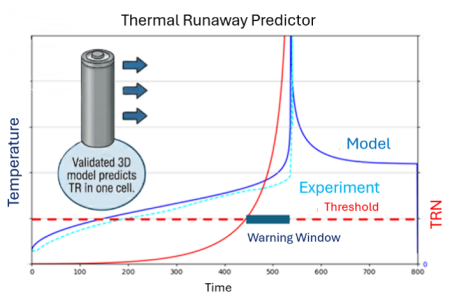
Thermal runaway represents one of the most critical safety hazards in lithium-ion energy storage systems, where self-accelerating exothermic decomposition reactions rapidly outpace the cell’s heat dissipation capabilities. In cylindrical battery formats, limited radial heat transfer allows internal core temperatures to reach critical thresholds while outer surfaces remain deceptively cool, rendering standard surface sensors unreliable for early hazard detection. To overcome this limitation, the BILDE lab develops physics-grounded, discrete heat transfer models incorporating Arrhenius kinetics to accurately predict thermal instability before catastrophic failure occurs. By continuously tracking the non-dimensional Thermal Runaway Number (TRN) and optimizing kinetic parameters through multi-objective genetic algorithms (NSGAII), our modeling framework extends the early-warning detection window by up to two minutes. This additional lead time provides a vital safety margin for next-generation Battery Management Systems (BMS) to trigger automated cooling, isolate compromised cells, or initiate emergency protocols prior to irreversible runaway.
Mechanical Impact and Damage Modeling
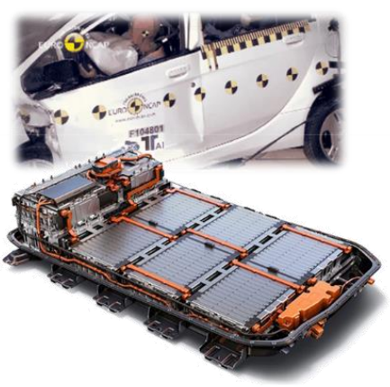
Mechanical impact and damage modeling in commercial lithium-ion pouch cells demonstrates that non-catastrophic dynamic impacts induce severe long-term capacity fade and internal resistance growth, even when no immediate short circuit occurs. Evaluating dynamic impact testing across various impact energies, initial states of charge (SOC), and extended cycling reveals that cell survivability depends directly on impact magnitude—where higher impact energies dictate immediate or delayed internal short circuits—while initial SOC has a minimal effect on overall structural failure thresholds. Mechanical indentation produces a characteristic response characterized by initial linear elastic compression, a softening plateau, and non-linear plastic damage, during which internal electrode layers undergo dynamic buckling post-impact. Long-term electrochemical degradation is captured using an equivalent circuit model, where bulk ohmic resistance and dynamic polarization elements track interfacial kinetics, solid electrolyte interphase (SEI) growth, and charge-transfer resistance. Characterization data indicates that dynamic impacts produce progressive increases in internal resistance parameters over extended cycling. Consequently, surviving impacted cells experience accelerated capacity fade and resistance growth driven by sub-critical microstructural damage modes such as separator tearing, localized loss of active material, electrode delamination, SEI layer fracture, and active particle pulverization.
Structural Batteries
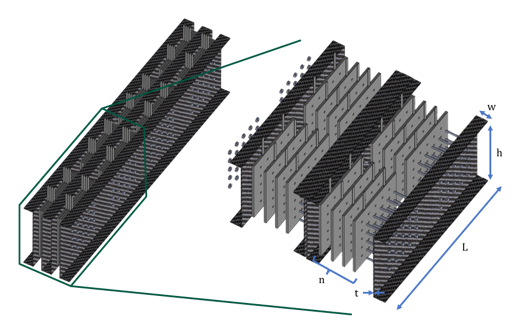
The high combustibility of Li-ion’s organic electrolyte requires EV designers to thoroughly protect their Li-ion battery packs from impact and other external forces, as well as monitor the battery health to prevent overcharging, over-discharging, thermal runaway, and disproportional voltages of cells in series. While each of these subsystems is important and necessary, they are currently unifunctional and independent. In the worst case, these supporting subsystems can be as much as 42% of the battery pack mass, leaving only 58% of the mass for storing energy. By integrating three subsystems – battery, structure, health monitoring and control – into one multifunctional system, the overall efficiency of the battery system is enhanced by keeping total energy constant while decreasing system-level weight.
Battery Health Degradation Modeling
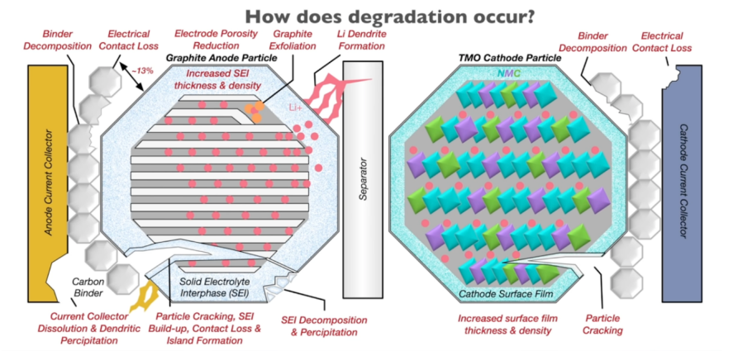
One of the most significant issues plaguing Li-ion battery use in EVs is the unpredictability of the capacity degradation of each cell. Even nominally identical batteries from the same manufacturing line can have drastically different cycle lives due to the variety of possible degradation mechanisms at the atomic level. Further complicating this problem is the fact that it is difficult to distinguish the performance of individual batteries at the pack level once they are all strung together in series. Auto manufacturers resolve this issue by limiting the usable capacity of the battery to minimize the rate of degradation at the cost of vehicle range. By understanding, modeling, and predicting the degradation behavior of individual cells in the battery pack, the limitation on the pack capacity can be reduced to increase the range of EVs.